Flag of Greece
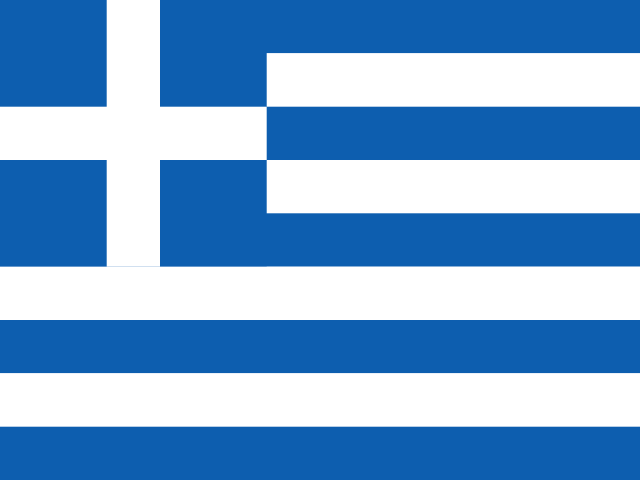
Nine equal horizontal stripes, five blue and four white, with blue at the top and bottom. A blue square in the upper hoist corner carries a white cross.
What the flag means
The stripes have no official meaning. The most popular explanation links the nine stripes to the nine syllables of the motto 'Eleftheria i Thanatos' (Freedom or Death). Blue and white are often associated with the Greek sky and sea, and the cross with Christianity.
History
The First National Assembly at Epidaurus adopted a national flag on 13 January 1822, and a decree of 15 March 1822 set out a land flag, a white cross on blue, and a striped flag for warships. From 1828 merchant ships flew the striped flag too. Until 1969 the cross design, at times with a royal crown, was the flag used on land. The military government made the striped flag the only national flag in 1969. The land flag replaced it in 1975, and Law 851/1978 restored the stripes.
Law 851/1978 calls the colours cyan and white and fixes no shade, so the blue on Greek flags varies. Dark blue has been common since the late 1960s.
Earlier flags of Greece
- 1970–1975Striped flag in proportions of 7:12, set under the military government
- 1975–1978White cross on a plain blue field, the former land flag
Flags of Greece's neighbours
Sources
- Wikipedia: Flag of Greece
Last reviewed 24 October 2026. Read how we research flags in our editorial policy, or report a mistake.