Flag of Kiribati
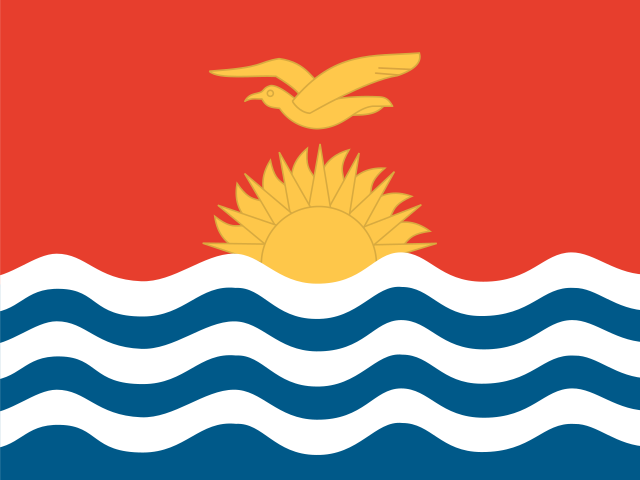
The upper half is red with a gold frigatebird flying over a rising gold sun with 17 rays. The lower half is blue with three white wavy bands.
What the flag means
The National Identity Act 1989 says the frigatebird stands for power, freedom and Kiribati dance patterns, the sun for the tropical sun of a country astride the Equator, and the sea for the Pacific Ocean. The 17 rays are usually read as the 16 Gilbert Islands and Banaba, and the three white bands as the Gilbert, Phoenix and Line Islands.
History
The design comes from the shield of the arms granted to the Gilbert and Ellice Islands colony in 1937. Before independence, a local competition chose a flag based on those arms. The College of Arms proposed a version with a larger bird and sun and narrower waves, but local people insisted on the original layout. The flag was first raised in Tarawa at independence on 12 July 1979.
The flag is an armorial banner: it repeats the shield of the national coat of arms exactly.
Earlier flags of Kiribati
- 1937–1976Gilbert and Ellice Islands Blue Ensign with the colony's shield in the fly
Sources
- Wikipedia: Flag of Kiribati
- Flags of the World: Kiribati
Last reviewed 24 October 2026. Read how we research flags in our editorial policy, or report a mistake.