Flag of Tuvalu
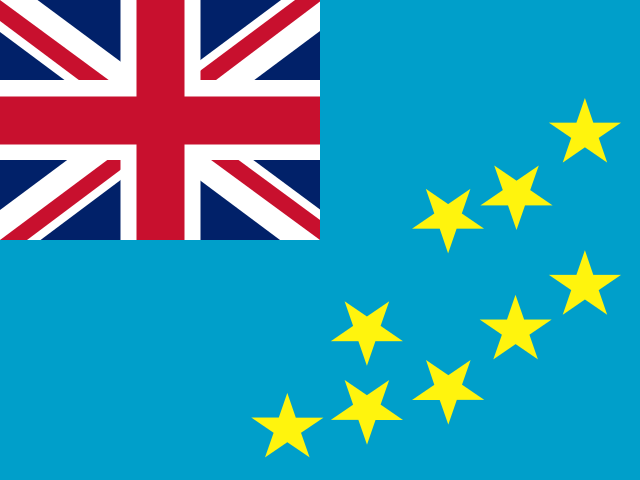
A light blue field with the Union Jack in the upper hoist. Nine yellow five-pointed stars in the fly are laid out like a map of the islands.
What the flag means
The nine stars are the nine islands, placed to match their positions. The Union Jack refers to ties with the United Kingdom and the Commonwealth. The Tuvalu National Flag Act fixes the direction of every star, but no official text explains why some point up and others down.
History
Vione Natano's design was chosen from 40 entries and adopted at independence on 1 October 1978. In 1995 Prime Minister Kamuta Latasi's government replaced it with a flag of light blue and red bands, eight stars and the coat of arms, with no Union Jack. The new flag was unpopular, and after Latasi lost a vote of no confidence in December 1996 the 1978 design was restored on 11 April 1997.
The name Tuvalu refers to eight islands, the number first inhabited. The 1995 flag dropped a star to match, but the restored flag has nine.
Earlier flags of Tuvalu
- 1937–1975Gilbert and Ellice Islands Blue Ensign with the colony's coat of arms
- 1976–1978Blue Ensign with the coat of arms of Tuvalu
- 1995–1997Light blue and red bands, eight white stars, coat of arms in a white triangle
Sources
- Wikipedia: Flag of Tuvalu
- Flags of the World: Tuvalu
Last reviewed 24 October 2026. Read how we research flags in our editorial policy, or report a mistake.