Flag of Vanuatu
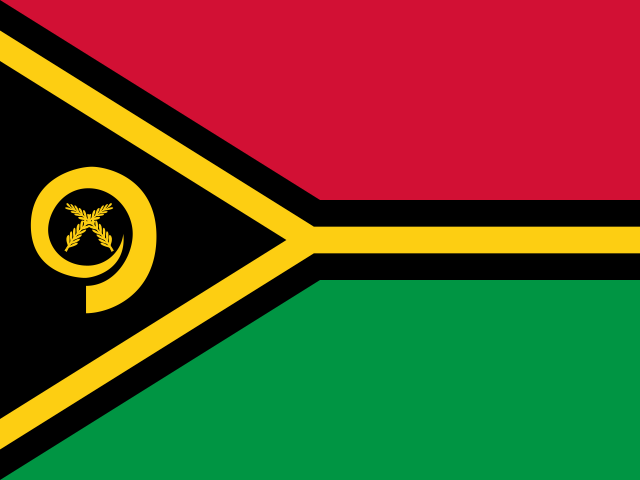
A yellow Y on its side, edged in black, separates a red upper band from a green lower band. It opens from a black triangle at the hoist, where a yellow boar's tusk circles two crossed namele leaves.
What the flag means
The colours come from the Vanua'aku Pati: black for the Melanesian people, red for blood, green for the islands and yellow for Christianity. The Y follows the pattern of the islands in the Pacific. The boar's tusk stands for prosperity, and the official description calls the namele leaves a token of peace.
History
In 1977 Kalontas Mahlon designed a flag in the same colours for the Vanua'aku Pati, the party that led the New Hebrides to independence as Vanuatu. A parliamentary committee chose the national design from local artists' entries, and it was adopted on 18 February 1980. Prime Minister Walter Lini asked for the yellow and black edging so that the black would stand out. The flag was flown at independence on 30 July 1980.
The namele leaves have 39 leaflets, one for each member of the first Parliament.
Earlier flags of Vanuatu
- 1906–1980Blue Ensign with the New Hebrides emblem, flown by the British administration
- 1906–1980French tricolour, flown by the French administration of the condominium
Sources
- Wikipedia: Flag of Vanuatu
- Flags of the World: Vanuatu
Last reviewed 24 October 2026. Read how we research flags in our editorial policy, or report a mistake.