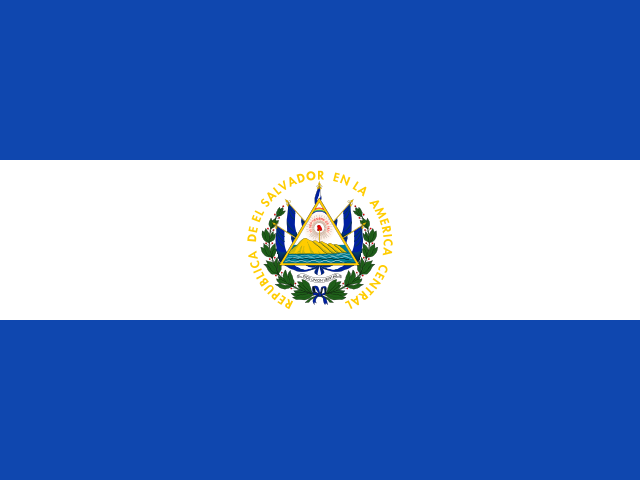
Flag of El Salvador
Three equal horizontal bands of blue, white and blue, with the national coat of arms in the centre. The version for public buildings has the motto 'Dios, Unión, Libertad' in place of the arms.
What the flag means
The Law of National Symbols of 14 September 1972 describes the flag but does not explain it. The presidency's website says the two blue stripes are the Pacific and Atlantic oceans on either side of Central America and the white stripe is peace. El Salvador itself has no Atlantic coast.
History
Manuel José Arce unveiled a blue and white flag on 20 February 1822. In 1865 El Salvador switched to blue and white stripes with a red canton of stars, a design close to the US flag. A legislative decree of 17 May 1912 restored the blue-white-blue of the old Central American federation, first raised on 15 September 1912. The coat of arms was revised in 1916, and the 1972 law sets the current rules.
The 1972 law sets three official versions: the Bandera Magna, 3.35 m by 1.89 m, for state occasions, a flag for public buildings and a parade flag.
Earlier flags of El Salvador
- 1822–1865Horizontal blue, white and blue stripes
- 1865–1912Blue and white stripes with a red canton of stars, rising from nine to fourteen
Flags that look like this one
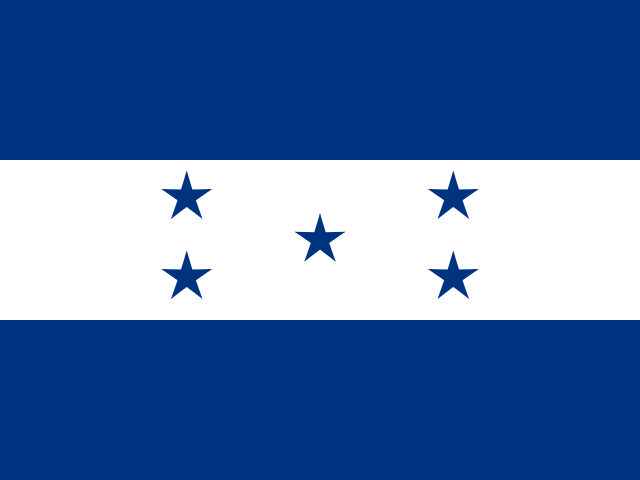
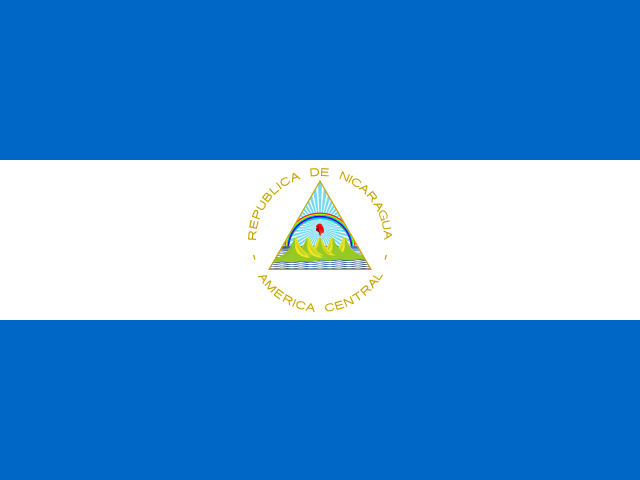
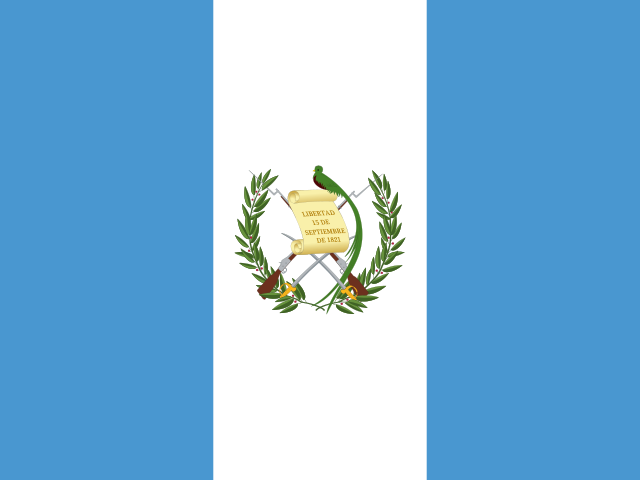
Blue, white, blue from the old Central American federation. Honduras has five blue stars. Nicaragua and El Salvador have different coats of arms in the centre. Guatemala's stripes are vertical and light blue.
Flags of El Salvador's neighbours
Sources
- Wikipedia: Flag of El Salvador
- Corte Suprema de Justicia de El Salvador: Ley de Símbolos Patrios (Decreto N.º 115, 1972)
Last reviewed 24 October 2026. Read how we research flags in our editorial policy, or report a mistake.